Exhibition Text — Encounter, Two Visions, 2024
'Encounter, Two Visions'
Shin Hee Won (Gallery Doll Curator)
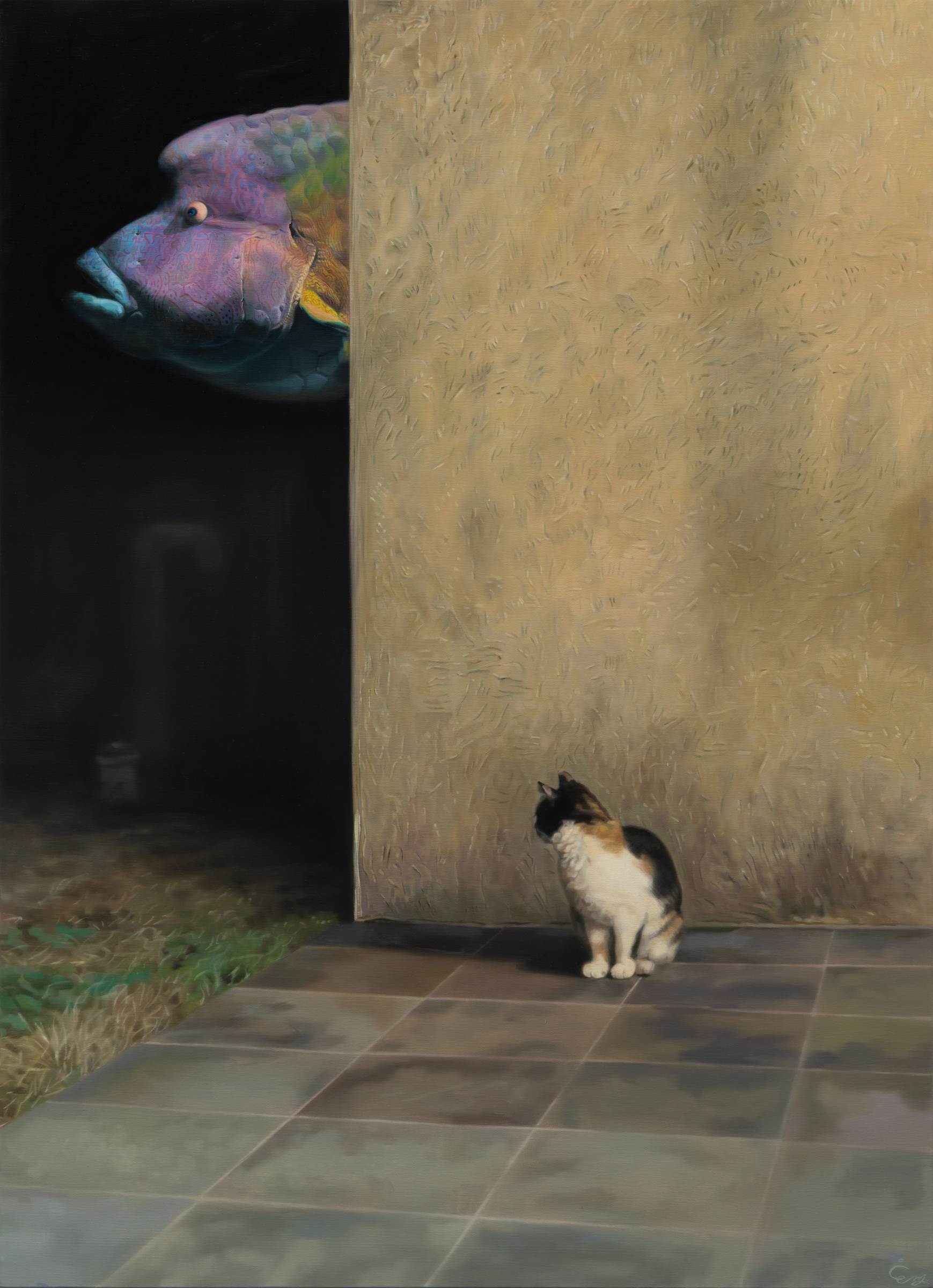
Cho Eunjoung’s paintings are grounded in the close observation of objects. Buildings appear in relation to natural settings, while carefully staged figures are placed in alignment with their surroundings, forming scenes that remain within an expanded field of landscape. Through symbolic displacement and the artist’s subjective gaze, objects begin to generate narratives, as though a novel were unfolding across the canvas. Rather than remaining as heterogeneous fragments, they establish a provisional harmony on the pictorial surface. Yet this harmony soon gives way to an ambiguous atmosphere, where familiar elements are connected through fictional and unexpected associations rather than a consistent narrative context.
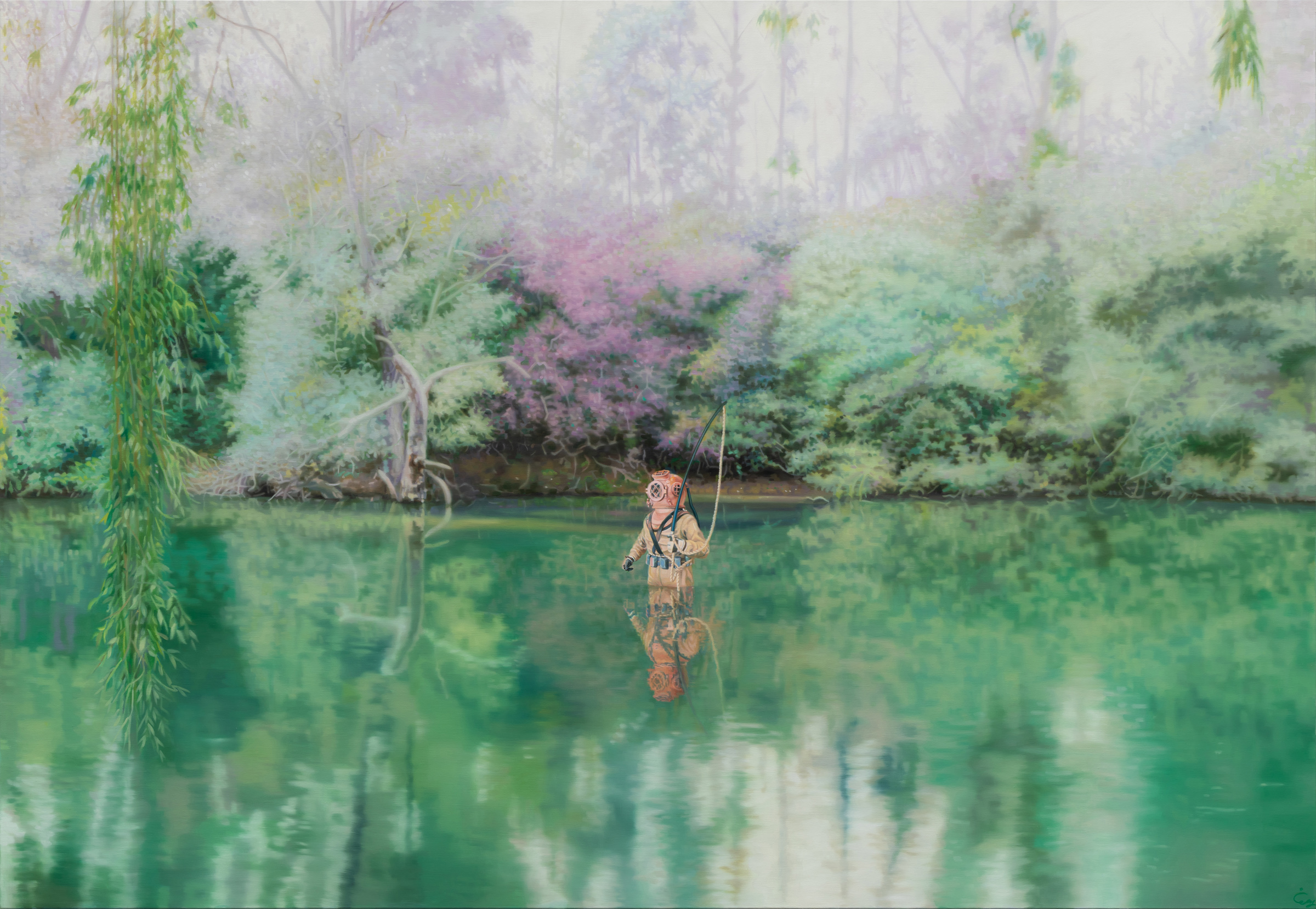
Their elusive quality prevents them from being grasped all at once. Unexpected encounters activate different areas of the composition, drawing the eye from one point to another. Whether viewed from a distance or at close range, the objects appear to seek a certain plausibility among themselves. In Cho’s recent works, dramatic movements such as eruption or the sensation of an endlessly falling space have become increasingly restrained. Form now emerges through concentrated attention to the placement of objects within the pictorial field. A sandcastle may stand above rippling water, while the movement of a diver in a lake does little more than suggest direction. As in Magritte’s *The Empire of Light*, where day and night coexist, everyday experience and memory return as sensation, carried through the scene like an imagined wind.
As time accumulates within the image, objects gradually enter the space. The stories Cho wishes to construct are abundant, yet no single cause, outcome, or event becomes fully visible. Although her paintings remain representational, they reveal the artist’s sustained search for inner balance through compositions that subtly displace reality. Forms waver, settle, and regain their orientation. These works are not concerned with staging trauma. Instead, they gather feelings that can be sensed but not fully explained and allow them to take shape as objects.
Cho observes the world while revealing reality through the filter of her own sensibility. A dreamlike atmosphere may appear luminous, only to move toward darkness. The desire to bring things into clearer view accumulates like a residue of the unconscious. Somewhere near the boundary between these conditions, the artist locates herself.
A sense of anxiety underlies the work. Fear, tension, and unfamiliarity arrive in mixed form and are given material presence on the canvas. Painting becomes a means of examining what might be endured, overcome, or transformed when it encounters something new. At times, Cho reflects on the existence of the self by placing reality at a slight remove. When lack and fulfillment give rise to desire, how far can anxiety extend? The paintings may begin with the artist’s own experience, but they gradually open onto narratives of relation shaped by the recognition that no one lives alone.
Cho’s paintings also reflect a society sustained by interlocking relations, including those between people who may never know one another. Objects generate unexpected situations precisely because they occupy this shared yet unstable field. The artist restrains overt emotional expression and looks steadily into space. The unconscious does not emerge outside society, but through its rules, pressures, and prohibitions. Reason, belief, and desire have moved toward the category of “we,” producing the vast structure called society. Yet within that structure, the place available to the individual appears increasingly diminished. How, then, should one live? Cho allows this question to deepen without forcing it toward a definitive answer.
If the fog were lifted, would we finally be able to see? In these works, the dreamer becomes a diver and continues moving toward life. Even when life is understood as a sea of suffering, the strength to continue emerges from the immeasurable flow of time. We move forward by placing hope in a future that cannot be predicted.
Cho’s paintings envelop the objects and sensations attached to life within a luminous, carefully constructed atmosphere, allowing the inner self to settle. Her work does not deny the limits or uncertainties of human existence. Instead, it approaches reality as something to be observed, endured, and gradually accepted. Inner balance, in this context, is not a state of complete resolution. It is a provisional condition, repeatedly recovered through observation, time, and the persistence of living.
'Texts > Critical Texts' 카테고리의 다른 글
| Exhibition Text — Orbit, 2026 (0) | 2026.08.06 |
|---|---|
| Exhibition Text — It is everywhere, 2023 (0) | 2023.11.14 |
| Exhibition Text — Unfamiliarly Glittering, 2022 (0) | 2023.01.12 |
| Exhibition Text — The Desire to Communicate in an Age Incapable of It, 2019 (0) | 2019.09.26 |
| Critical Text — Dual Conditions of Human Existence, 2016 (0) | 2019.09.13 |