Exhibition Text — Orbit, 2026
‘Otbit’
Shin Hee Won (Gallery Doll Curator)
Cho Eunjoung’s recent body of work, the Orbit Series, begins with a question: how does inner balance take shape, and how can it be sustained? The forms that appear in her paintings are clearly defined, yet they evoke an unfamiliar sensation that seems to extend beyond everyday reality. Poised between familiarity and estrangement, they establish a visual logic of their own.
Here, balance does not refer to a fixed state of harmony. Rather, it describes a condition in which different emotions and beings can remain in relation without either fully colliding or drifting irretrievably apart. Cho visualizes this relational structure through the concept of orbit. In her work, an orbit is not simply a trajectory around a single center, but a relational order structured and sustained by distance, allowing distinct presences to coexist without destabilizing the relation between them.
Cho’s earlier paintings centered on the tension between reality and fantasy. Through a distinctly personal gaze, she depicted small presences situated within forests, ruins, and dreamlike spaces, giving form to an inner desire to move beyond the order of reality. The pictorial field unfolded as a psychological scene in which reality and the unconscious came into conflict. Here, fantasy did not function simply as an unreal realm, but as a space in which desires and emotions left unfulfilled in reality could emerge. In this sense, Cho’s earlier paintings resonate with a Freudian psychoanalytic view in which reality constrains desire, while fantasy provides a space for repressed impulses to find expression.
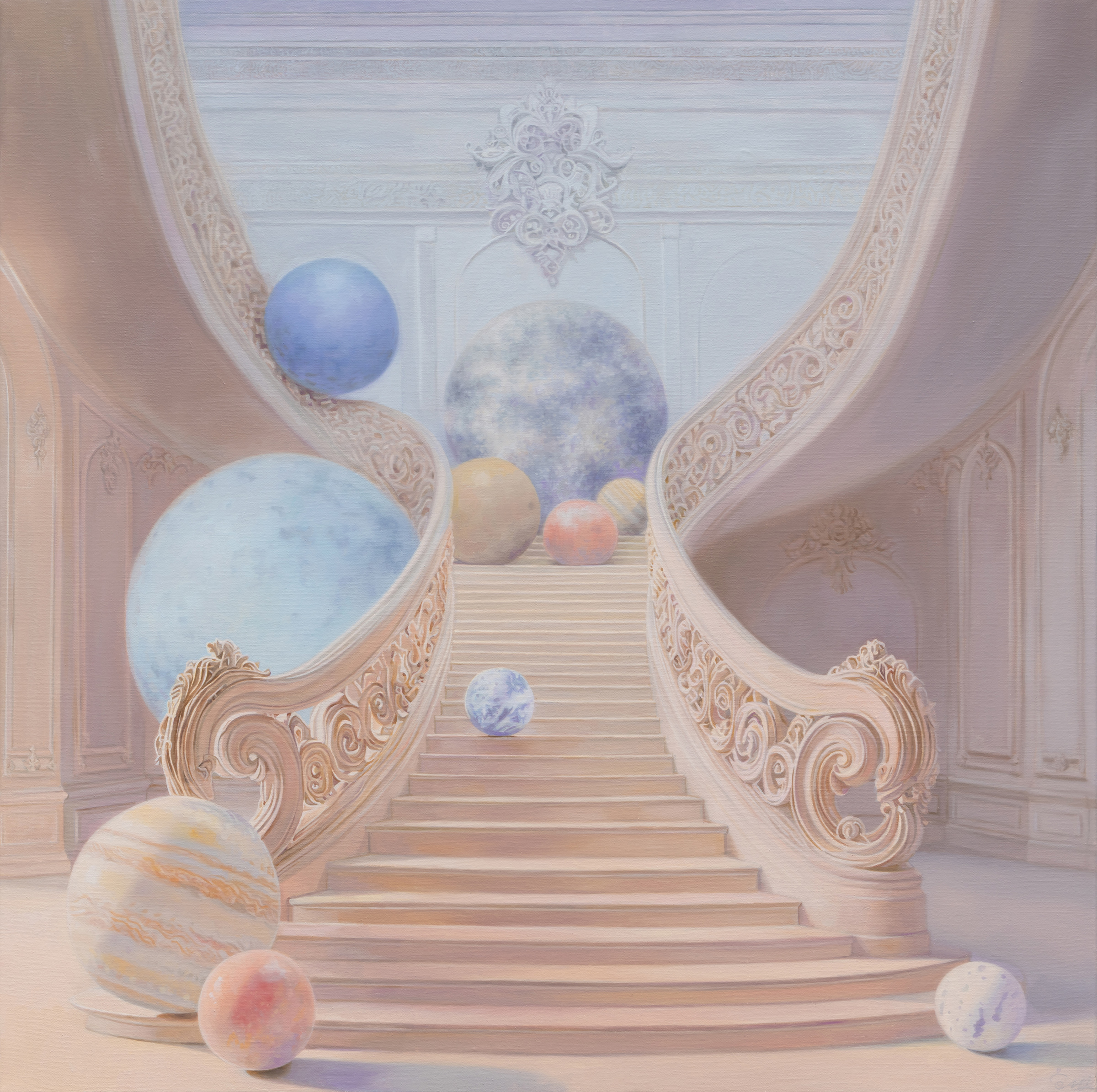
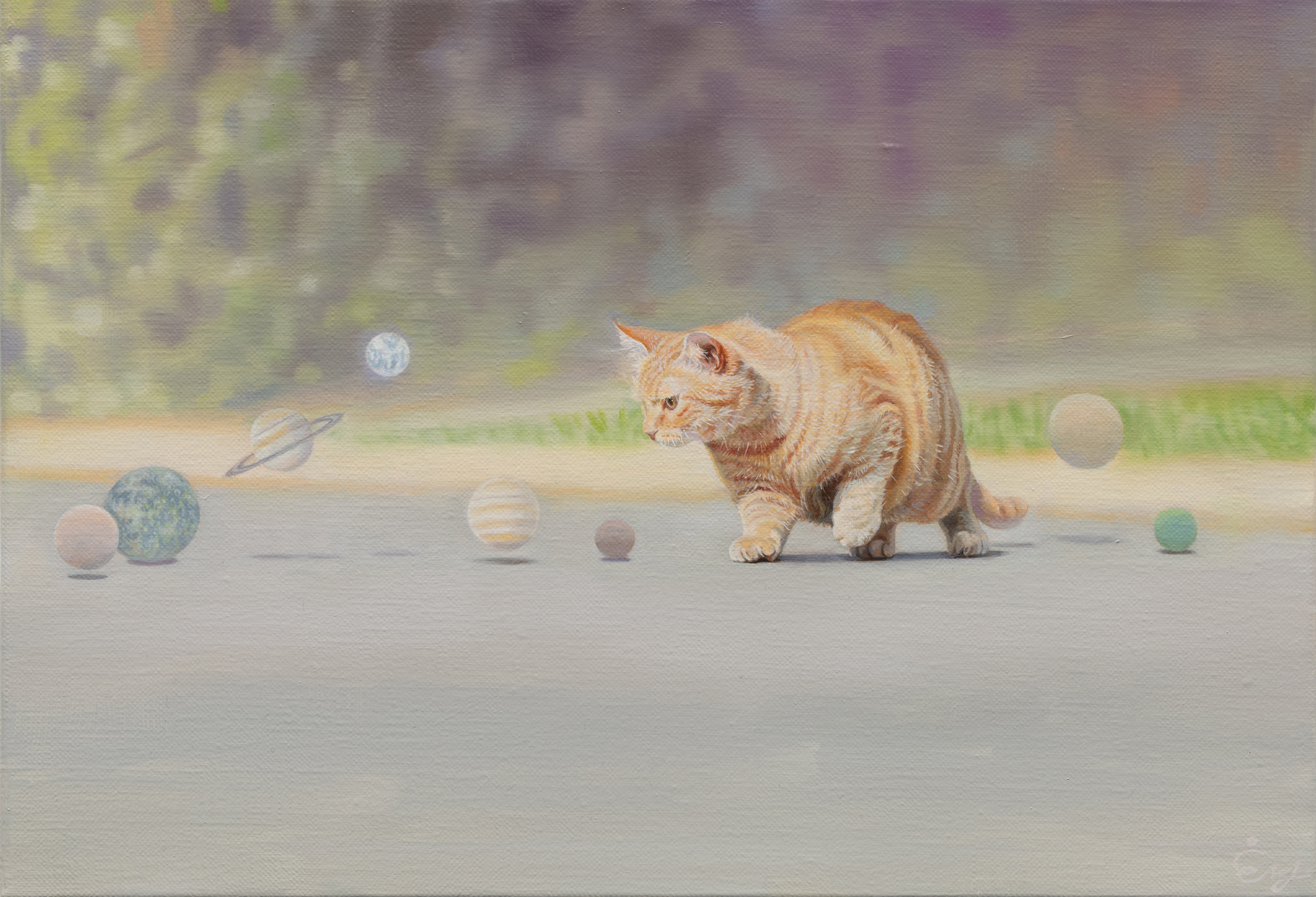
With the emergence of the Orbit Series, however, Cho’s attention shifts from desire itself to the ways in which relationships are formed. The planets in these paintings are not remote objects to be reached in outer space. They coexist within a shared scene, maintaining measured intervals from one another. In doing so, they reveal relational distances between one emotion and another, and between one person and another.
What matters here is not what each planet signifies, but the distance and rhythm that emerge between them. A relationship cannot be sustained when its participants are either too distant or excessively close. Inner balance is therefore not a state achieved by an isolated individual, but a process that unfolds as different beings continually adjust their relations to one another. The planets move alongside a cat and drift through gardens, arcades, and spaces above water, continually entering new relational configurations.
This shift may also be understood within a broader trajectory of psychoanalytic thought. While Freud often approached the unconscious through the interpretation of symbolic formations, Melanie Klein focused on the process through which the subject initially experiences the object as divided into “good” and “bad,” before gradually recognizing these opposing qualities as belonging to the same object. Donald Winnicott described how human beings form a sense of self through play and interaction within a transitional space between reality and fantasy, self and other.
This transitional space makes it possible to sustain a relationship without fully possessing or completely understanding the other, allowing difference to remain intact. In Cho’s paintings, landscapes inhabited by planets and other objects function as mediating structures through which such transitional spaces can emerge. Rather than resolving or explaining emotions directly, they create a distance that allows emotions to remain temporarily and become bearable without immediate resolution.
Cho’s paintings similarly direct attention away from the interpretation of isolated symbols and toward the process through which different forms come together to constitute a scene. Palaces and stairways, arcades and planets, trees and water retain clearly recognizable forms, yet none is confined to a single meaning. Within the pictorial field, these elements respond to one another, accommodate one another’s presence, and generate new landscapes.
The spaces that open beyond arched doorways do not function as boundaries separating reality from fantasy. Instead, they become sites where different emotions and memories may temporarily settle and give rise to new forms of perception. Bringing together stillness and movement, stability and transformation, these spaces hold the uncertainty of life while suggesting the possibility that distinct beings may inhabit a shared world.
The recurring gardens, arcades, spaces above water, and subterranean architectural structures are likewise more than scenic backgrounds. They function as interior terrains where emotions settle and circulate, as well as protected spaces capable of accommodating different forms of existence. Like Winnicott’s concept of the “holding environment,” Cho’s spaces do not eliminate anxiety. Rather, they provide the conditions in which emotions can be held without collapse or fragmentation. This is also why the planets in her paintings neither collide with one another nor disperse entirely.
Ultimately, balance in the Orbit Series is not a completed state. It is an ongoing process that continues to shift and must be recalibrated in order to sustain relationships. Through the orbits of her planets, Cho considers how human beings establish and negotiate appropriate distances between themselves and others, as well as between themselves and their own emotions.
Reality and fantasy, consciousness and the unconscious, isolation and connection no longer operate solely as opposing forces. Without invading or erasing one another, they coexist within a single pictorial field. Cho’s paintings thus quietly propose inner balance not as a final resolution, but as a relational condition continually formed anew within relationships.
'Texts > Critical Texts' 카테고리의 다른 글
| Exhibition Text — Encounter, Two Visions, 2024 (0) | 2024.11.13 |
|---|---|
| Exhibition Text — It is everywhere, 2023 (0) | 2023.11.14 |
| Exhibition Text — Unfamiliarly Glittering, 2022 (0) | 2023.01.12 |
| Exhibition Text — The Desire to Communicate in an Age Incapable of It, 2019 (0) | 2019.09.26 |
| Critical Text — Dual Conditions of Human Existence, 2016 (0) | 2019.09.13 |